TSMC stock price reaction and market share guide
"The semiconductor industry is the backbone of the modern digital economy, and its largest players dictate the rhythm of global markets."
Investors closely monitor TSMC stock price reaction to understand broader semiconductor market trends and manage portfolio risk. This guide is for those tracking high-growth tech stocks, comparing historical growth rates, and understanding how single-company fluctuations impact national indices.
You should note that while historical growth is high, past performance does not guarantee future stability in volatile tech sectors.

* TSMC commands approximately 70% of the global semiconductor foundry market share. * The company represents about 30% of the Taiwan Stock Exchange's main index. * Since 1994, the firm has achieved a revenue CAGR of 17.4% and an earnings CAGR of 16.1%. * Integrated circuit exports reached $184 billion in 2022, nearly 25% of Taiwan's GDP.
How does TSMC stock price reaction influence the local market?
At dawn in the Taipei trading floor, the trader feels a sudden chill as the tsmc stock price reaction flashes across the screen.
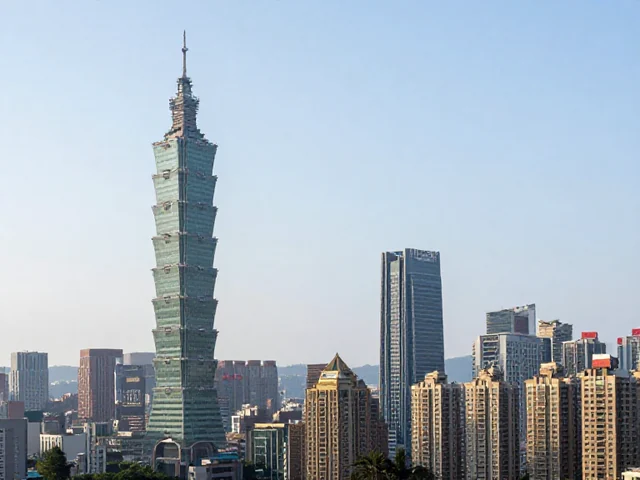
A trader watches the glowing red and green numbers on a monitor in Taipei as the market opens. Since TSMC accounts for approximately 30% of the Taiwan Stock Exchange's main index, its movement often dictates the direction of the entire local market.
When this specific stock shifts, the index follows.
The scale of this influence is significant for anyone studying Taiwan semiconductor trends. Because the company is such a massive component of the local index, its individual volatility can create a ripple effect across diverse sectors.
This connection makes the stock a primary indicator for the health of the regional economy.
What is TSMC's strategy for long-term investors?
Deep in the quiet office at midnight, the analyst rubs weary eyes while studying the tsmc strategy for long-term growth. Late at night in the dim office, the analyst rubs tired eyes while studying the tsmc investment strategy.
An analyst pores over decade-long spreadsheets to find patterns in revenue growth. To build a TSMC investment strategy, one must look past short-term noise and focus on the company's historical compounding power.
Long-term participants often prioritize the firm's dominant market position and its ability to maintain high growth rates.
This consistent growth suggests a pattern of scaling that has lasted decades.
I observed how these historical figures serve as a benchmark for many who attempt to time their entries into the semiconductor sector.
How can a semiconductor guide help me manage risk?
A researcher sits in a quiet library, cross-referencing global supply chain reports with manufacturing capacity data. Using a semiconductor market guide involves looking at the physical constraints of production, such as wafer capacity and process node advancements.

Understanding these technical limits helps investors predict when supply might meet or fail demand.
The company's technical reach is vast, producing chips with process nodes ranging from 2 microns to 3 nanometres. As of 2020, the firm maintained a global capacity of about thirteen million 300 mm-equivalent wafers per year.
These production metrics are essential for evaluating the company's ability to handle market shifts.
How do I approach trading TSMC stocks during volatility?
A person sits at a desk, nervously checking a mobile trading app during a period of intense market movement. When you are trading TSMC stocks, you must account for the fact that the company's success is deeply tied to national economic health.
This requires a dual focus on both corporate earnings and macroeconomic export data.
The economic weight of the sector is clear, as Taiwan's exports of integrated circuits amounted to $184 billion in 2022, nearly 25 percent of Taiwan's GDP. This massive figure shows that the company's performance is not just a corporate matter but a national one.
High volatility in the stock often reflects broader shifts in these massive export flows.
What are the steps to evaluate a semiconductor company?
An investor opens a new brokerage account and begins the process of fundamental analysis. To evaluate a company like this, follow these three steps:
- Analyze the market share to ensure the company holds a commanding position, such as the approximately 70% share held in the foundry market. 2. Review the historical CAGR for both revenue and earnings to determine if growth is sustainable over decades. 3. Examine the capital structure and government involvement to understand the level of institutional support.
After completing these, perform a final check by comparing the company's R&D spending against its competitors to see if it is maintaining its technological edge. I found that looking at the relationship between R&D and capacity expansion provides a clearer picture of future readiness.
Comparison of Growth and Market Impact
| Metric | Value |
|---|---|
| Revenue CAGR (Since 1994) | 17.4% |
| Earnings CAGR (Since 1994) | 16.1% |
The table above highlights the historical consistency of the company's financial performance. While these figures are based on historical data, they represent the foundational strength that investors use to justify long-term positions.
- How does TSMC stock price reaction influence the local market?
- What defines the TSMC investment strategy for long-term holders?
- Can I use a semiconductor market guide to manage risk?
The same subject is also called TSMC stock volatility.
The same subject is also called TSMC investor sentiment.
The same subject is also called Taiwan stock market news.
Related
- Taiwan AI economic strategy drives tech innovation
- How is Taiwan semiconductor tech evolving?: 350 mm
Why should investors compare CAGR metrics?
Comparing revenue CAGR and earnings CAGR allows an investor to see if profit growth aligns with top-line expansion. A revenue CAGR of 17.4% compared to an earnings CAGR of 16.1% shows how the company scales its income alongside its bottom line.
This comparison helps determine if the semiconductor industry leader maintains consistent efficiency as it grows.
What risks arise from high market concentration?
High concentration in the foundry market creates a condition where a single company's performance dictates global semiconductor trends. Because the firm holds 70% of the market, any production shift affects the entire industry.
Investors must caution themselves that such dominance makes the stock highly sensitive to any changes in global demand or manufacturing capacity.
When evaluating the Taiwan Stock Exchange, one must compare the company's 30% index weight against other components. This comparison shows that the index is more susceptible to the company's specific volatility than to other local sectors.
Such a condition means that the semiconductor sector's health is essentially the health of the local market.
Wikipedia: Stock exchange (full) Based on the retained excerpt mentioning Soviet Union: Another example is Tashkent Stock Exchange established in 1994, three years after the collapse of the Soviet Union, mainly state-owned but has a form of a public corporation (joint-stock company).




Comments 0